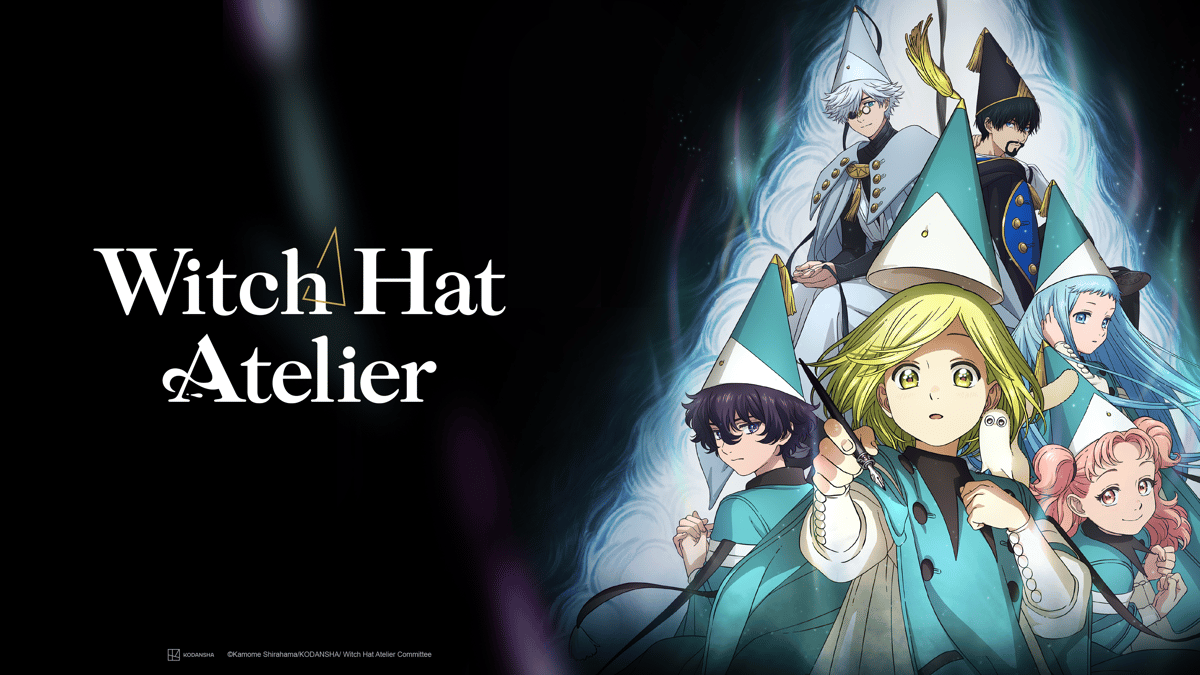
Witch Hat Atelier has wasted absolutely no time proving why its long-awaited anime adaptation was met with such massive anticipation. Across its first five episodes, the series doesn’t simply present a beautiful fantasy world filled with magic and wonder, it carefully builds a layered narrative centered on power, control, knowledge, and the consequences of restricting access to all three.
At its core, Witch Hat Atelier is not just about magic. It is about who gets to wield it, who is denied it, and what happens when systems built on exclusivity begin to crack.
A Fantasy World Built on Restriction
The opening episodes introduce Coco, a young girl whose love for magic has always been defined by longing. Raised to believe that only witches born into magical bloodlines can truly cast spells, Coco sees magic as something beautiful but forever beyond her reach.
That illusion is shattered when she discovers the truth: magic is not an inherited gift, but rather a learned skill based on symbols and spellcraft that has been intentionally hidden from ordinary people.
This revelation changes everything.
Coco’s accidental use of forbidden magic, which tragically petrifies her mother, becomes both the inciting incident and the story’s clearest thematic statement. The disaster itself raises immediate questions. Was the tragedy truly caused by magic itself? Or was it caused by a system that deliberately withheld knowledge, leaving Coco vulnerable to manipulation?
That distinction is what gives Witch Hat Atelier its emotional and philosophical weight.
Magic as a Symbol of Power
What makes Witch Hat Atelier especially compelling is how openly it frames magic as a metaphor for power structures.
The witches’ society is built on strict divisions between insiders and outsiders, between those allowed knowledge and those forbidden from it. Publicly, this restriction is justified as a necessary safeguard against dangerous misuse. But the deeper implication is harder to ignore: those in power rarely wish to share it.
This dynamic immediately creates fascinating moral ambiguity.
The Brimmed Caps, presented initially as dangerous rogue witches, clearly challenge the established magical order. Yet their actions are not portrayed as purely evil. In fact, they are the ones who first allow Coco access to magic, suggesting that their goals may be more ideologically complex than simple villainy.
Meanwhile, the supposedly lawful Brimless witches enforce a rigid magical hierarchy that feels increasingly suspicious the more we learn about it.
Rather than offering simplistic good-versus-evil conflict, the series thrives in moral gray areas.
Coco Is an Outstanding Protagonist
Coco immediately establishes herself as one of fantasy anime’s most compelling young leads.
Her resourcefulness, creativity, and emotional vulnerability make her deeply sympathetic. Unlike traditional chosen-one protagonists, Coco’s strength comes not from innate superiority, but from her perspective as an outsider.
Because she wasn’t raised within the rigid magical establishment, she approaches spellcraft with flexibility, wonder, and innovation that more traditionally trained witches often lack.
This difference becomes especially apparent during her early tests and challenges, where her upbringing and practical experiences often allow her to solve problems in ways others cannot.
Coco’s love for magic remains genuine, even after it destroys her old life, which adds remarkable emotional complexity to her journey.
Qifrey: Mentor, Protector, or Something More?
Qifrey is quickly shaping up to be one of the story’s most intriguing figures.
While he clearly acts as Coco’s protector and teacher, the anime consistently hints that his motivations are far more layered than simple altruism. His personal interest in the Brimmed Caps, his unusual isolation from mainstream witch society, and his guarded behavior all suggest deeper secrets.
Qifrey’s role feels intentionally ambiguous. He may genuinely care for Coco, but there is also a growing sense that he may be using her connection to forbidden magic as part of his own larger agenda.
This uncertainty makes him far more compelling than a straightforward mentor archetype.
Agott’s Role as Conflict and Social Commentary
Agott remains one of the series’ most frustrating yet narratively important characters.
Her hostility toward Coco initially paints her as little more than a cruel bully, but the series gradually suggests that her behavior may stem less from inherent malice and more from the rigid, perfection-driven structures she herself was raised within.
That does not excuse her cruelty, but it does add important nuance.
Agott’s behavior serves as a reflection of the broader magical system’s exclusionary values. She is, in many ways, a child reproducing the elitism and prejudice she has inherited from the world around her.
By contrast, Tetia’s warmth and humility highlight how drastically different environments shape young witches.
This subtle exploration of childhood socialization adds another impressive thematic layer to the series.
Visuals and Production Quality Are Exceptional
From an artistic standpoint, Witch Hat Atelier is absolutely breathtaking.
BUG FILMS has delivered one of the most visually enchanting anime productions of recent years, perfectly preserving Kamome Shirahama’s signature storybook-inspired art style while elevating it through fluid animation, rich environmental design, and extraordinary attention to magical detail.
The series often feels like a living illustrated fantasy novel.
The pop-up book aesthetic used in transitions, the intricate spell effects, and the overall environmental beauty all contribute to a world that feels immersive, whimsical, and deeply alive.
This visual excellence is not merely decorative. It actively reinforces the wonder, danger, and complexity of the magical system itself.
Episodes 1-5 Final Thoughts
After five episodes, Witch Hat Atelier has already established itself as one of the standout fantasy anime of 2026.
Its combination of extraordinary visual craftsmanship, emotionally resonant storytelling, and deeper thematic exploration of power, access, and institutional control gives it a sophistication rarely seen in mainstream fantasy adaptations.
Rather than simply telling a magical coming-of-age story, Witch Hat Atelier challenges viewers to question the systems that define who is allowed knowledge and why.
It is enchanting, unsettling, intellectually engaging, and emotionally powerful all at once.
If the anime can maintain this level of quality, both narratively and visually, it has the potential to become one of the defining fantasy series of its generation.
Score So Far: 9.4/10
Strengths: Incredible world-building, exceptional animation, complex themes, powerful protagonist, morally layered conflict, stunning art direction.
Weaknesses: Agott’s early cruelty may frustrate some viewers, larger mysteries still unfolding, pacing occasionally prioritizes setup over immediate payoff.
